
Case Study: Proactive Asset Management
December 2025, by Alok Mishra | Head – Asset Management Unit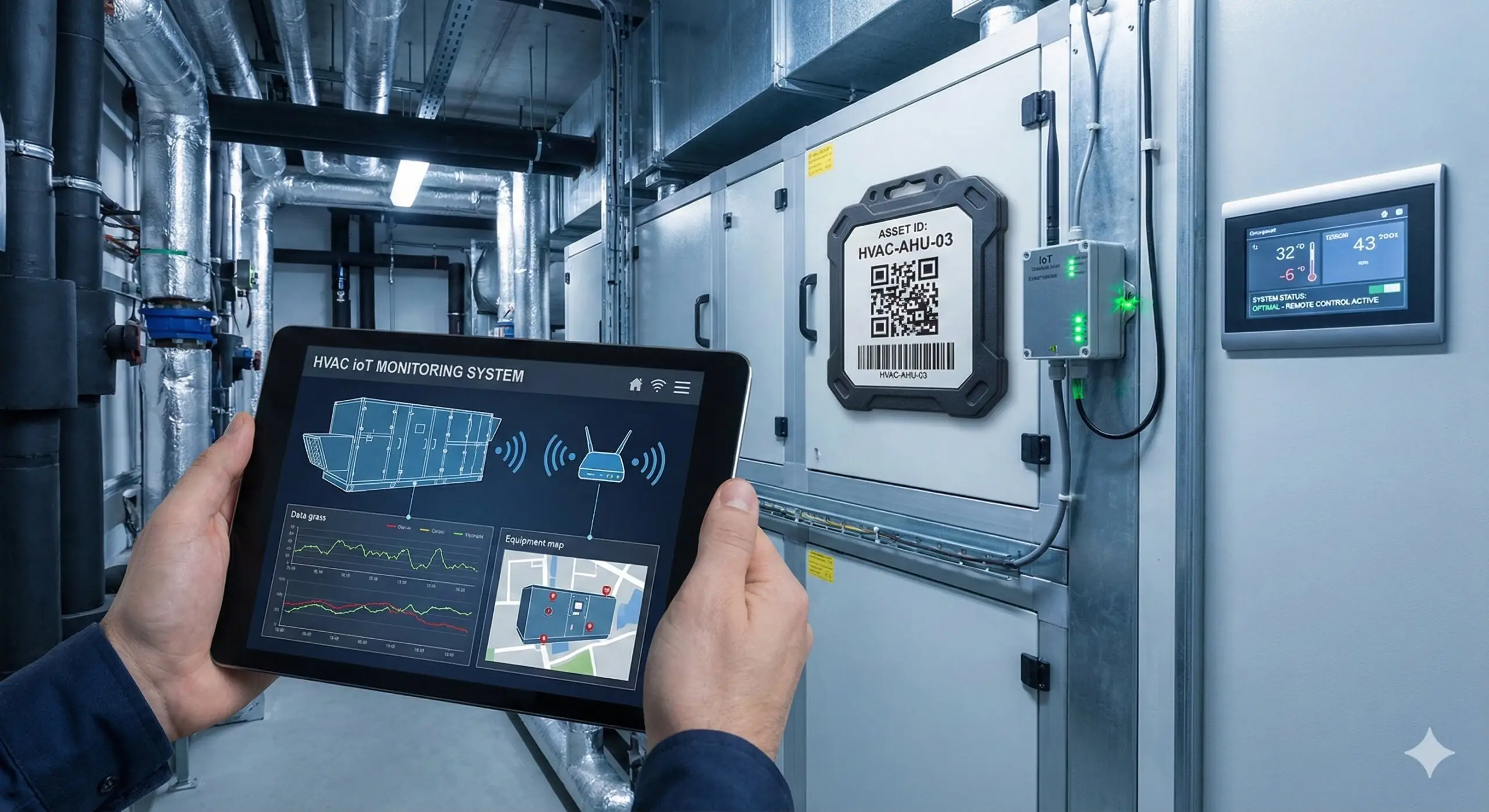
Key Takeaways:
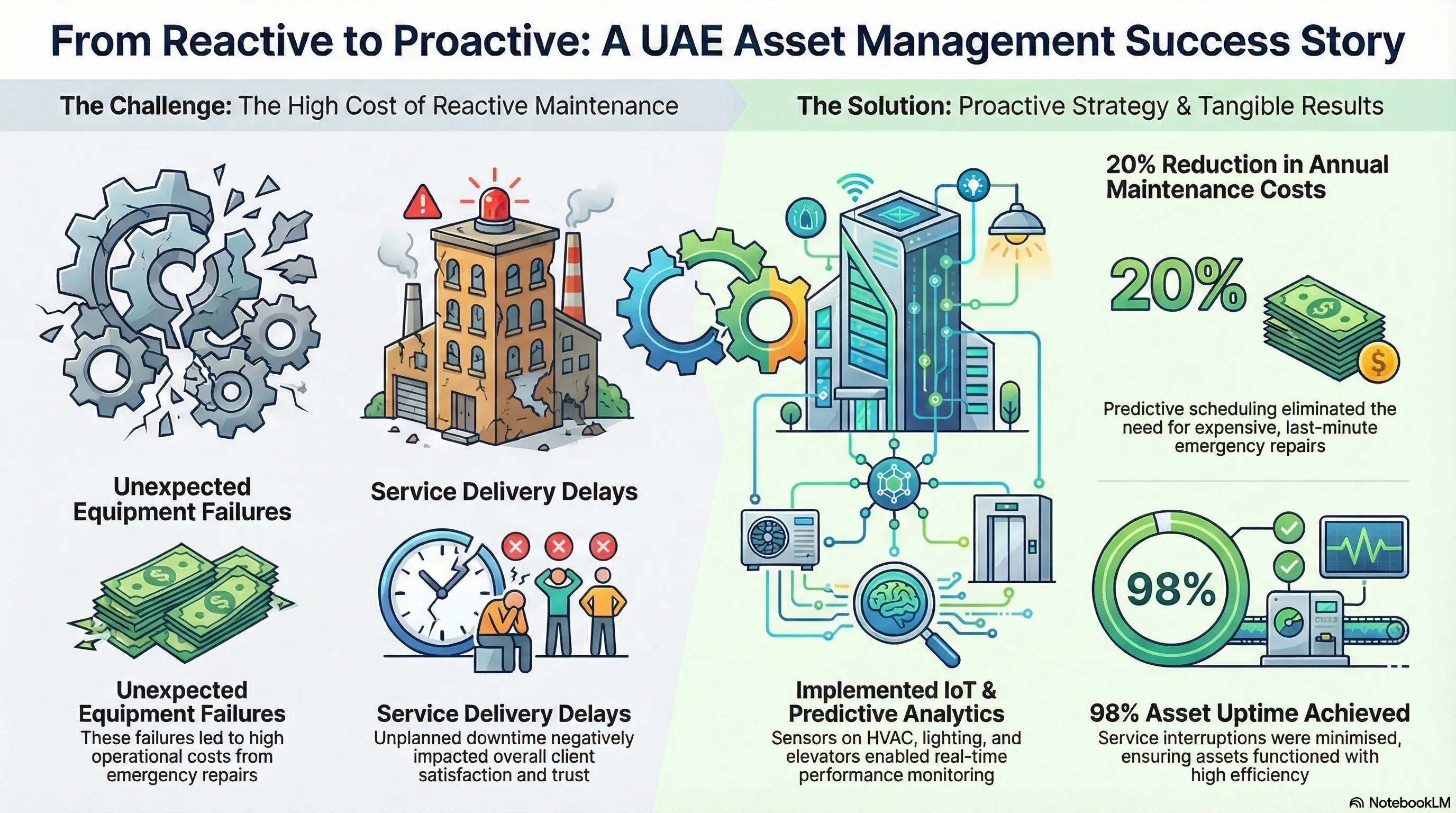
Proactive asset management through IoT sensors and predictive analytics transforms facility operations. Real-time monitoring of HVAC, lighting, and elevators detects wear before failure occurs. This approach cuts maintenance costs by 20%, achieves 98% uptime, and strengthens client trust. Prevention replaces reaction, aligning operational efficiency with UAE’s innovation vision.
Podcast Overview:
By Alok Mishra
The Challenge: Breaking the Reactive Maintenance Cycle:
A UAE-based facility management company was caught in the reactive maintenance trap that costs the industry billions annually. Unexpected equipment failures created operational chaos. Emergency repairs at premium rates. Service interruptions that strained tenant relationships. Maintenance budgets spiraling out of control.
The numbers revealed the damage. Emergency repairs cost up to three times more than planned maintenance. HVAC failures during peak summer months (when Dubai temperatures exceed 45°C) triggered immediate tenant complaints. Elevator outages disrupted daily operations for hundreds of occupants. Each breakdown demanded overtime labor, expedited parts shipping, and diverted resources away from preventive work.
Beyond direct costs, the reactive approach damaged client satisfaction and retention. Service delivery delays eroded trust. The maintenance team spent more time firefighting emergencies than optimizing operations. Traditional time-based preventive maintenance offered no solution. Fixed inspection schedules either performed unnecessary work or missed emerging issues between intervals.
The company needed more than a maintenance vendor. They needed a technology partner who understood both the operational challenges and the infrastructure required to solve them. They needed expertise spanning IoT sensors, network connectivity, data analytics, and facility operations. Capabilities rarely found under one roof.
The Solution: Integrated IoT Infrastructure From a Single Partner
Emircom’s integrated approach combined decades of networking and data center expertise with advanced IoT capabilities and asset management operations. This wasn’t simply installing sensors. It was architecting an intelligent infrastructure that transformed raw data into predictive insights.
The company implemented a proactive asset management strategy using Internet of Things (IoT) devices and predictive analytics. By equipping assets like HVAC systems, lighting, and elevators with IoT sensors, they could continuously monitor performance in real time. Predictive maintenance models analyzed the data to detect early signs of wear and tear. This enabled the team to schedule maintenance before a failure occurred.
The Infrastructure Foundation
Emircom deployed a comprehensive sensor ecosystem across critical assets. Industrial-grade temperature sensors with ±0.1°C accuracy monitored HVAC supply ducts, return air paths, and outdoor intakes. Vibration sensors on compressor housings and motor bearings tracked eight health indicators (VRMS, peak displacement, kurtosis). These revealed bearing wear and motor imbalance weeks before catastrophic failure. Air quality sensors measuring CO2, VOCs, and particulates enabled demand-controlled ventilation that adjusted airflow based on actual occupancy.
Lighting systems received occupancy sensors and power monitors tracking consumption patterns and ballast degradation. Elevators got vibration sensors on motor assemblies, temperature monitors in machine rooms, and load sensors for alignment tracking. Water systems deployed flood sensors triggering at 1.6mm depth, plus acoustic leak detectors for early pipeline failure warning.
The Single-Integrator Advantage
This is where Emircom’s multi-domain expertise created unique value. While competitors subcontract networking to one vendor, IoT to another, and analytics to a third, Emircom controlled the entire stack.
The sensors communicated through LoRaWAN wireless protocol, chosen for its 10-kilometer range, building penetration, and ten-year battery life. Emircom’s networking team architected the gateway infrastructure providing seamless coverage across 10,000+ square feet per building. No extensive cabling required.
The data center team built the cloud infrastructure running advanced analytics. Edge controllers performed immediate threshold checks locally. Edge gateways aggregated inputs and translated protocols. Cloud platforms ran CNN-LSTM hybrid machine learning models that achieved 96% prediction accuracy. This three-tier architecture (optimized by Emircom’s data center expertise) reduced latency from 200ms to under 50ms. Processing 80-90% of data locally cut bandwidth costs by 85%.
Emircom’s business technology specialists integrated the predictive system directly with the client’s CMMS and building management systems. When sensors detected conditions trending toward failure, work orders generated automatically. The system provided specific guidance: which component was degrading, predicted timeline to failure, recommended intervention. No manual data entry. No information silos. Complete operational integration.
“Most companies install sensors and hope for insights. We architected the entire infrastructure, from wireless networks to cloud analytics to CMMS integration. That’s the single-integrator advantage our clients can’t get anywhere else.”
Alok Mishra – Emircom
The Four-to-Six-Week Transformation
After baseline learning where algorithms captured “normal” operating signatures, the system began predicting equipment failures six to twelve weeks in advance. The deep learning models identified subtle degradation patterns invisible to human observation. Vibration frequency shifts indicating bearing wear. Temperature gradient changes revealing lubrication problems. Power consumption anomalies signaling motor winding degradation.
Maintenance teams received actionable intelligence, not raw data. Emircom’s asset management specialists worked alongside the client’s team, training them to interpret predictions, prioritize interventions, and optimize maintenance schedules around operational requirements rather than emergency response.
Measurable Results: Cost, Uptime, and Client Satisfaction
- Cost Savings:
Preventive actions eliminated costly emergency repairs, reducing maintenance expenses by 22% annually. Emergency repairs that previously cost triple planned rates vanished from the budget. Expedited parts shipping charges dropped 85%. Overtime crisis response fell 60%. Equipment lifespan extended 25%, deferring capital replacement by years.
When you include energy optimization from better-running equipment, total savings exceeded 30%. The predictive system returned 20 AED for every Dirham invested. That’s a 545% ROI with two-year payback.
- Improved Uptime:
Service interruptions were minimized, achieving 98% uptime. The six-to-twelve-week advance warning enabled scheduled maintenance during off-peak hours. Unplanned downtime dropped 45%. HVAC service calls fell 30%, keeping buildings comfortable through Dubai’s extreme heat. Elevator outages shifted from monthly occurrences to rare quarterly events. The maintenance team transformed from reactive firefighting to proactive optimization.
- Enhanced Client Satisfaction:
Timely interventions boosted service reliability in measurable ways. Tenant satisfaction scores increased 23 percentage points. Service response times improved 35% as teams pre-positioned parts with advance notice. Building managers reported 20% increases in positive reviews citing consistent comfort and reliable systems.
Tenant renewal rates climbed from 78% to 89%. That directly impacted revenue stability. The data-driven approach became a competitive differentiator, helping win three new managed property contracts.
- Operational Intelligence:
Beyond preventing failures, Emircom’s integrated platform revealed optimization opportunities invisible to traditional management. Energy consumption analytics identified off-hours equipment running unnecessarily. Occupancy patterns enabled right-sizing of HVAC zones. Water consumption monitoring detected slow leaks costing thousands monthly.
The single-integrator advantage meant these insights flowed seamlessly between building systems, networking infrastructure, and operational dashboards.
“Before implementing IoT-enabled predictive maintenance, we were constantly firefighting equipment failures. Now we’ve cut emergency repair costs by over 20% and achieved 98% uptime. But the real win is our improved client satisfaction scores. When you can prevent problems before they happen, it changes everything. From our bottom line to our reputation in the market.”
Customer Operation Director
The Takeaway: Why Single-Integrator Solutions Outperform
Proactive asset management transforms maintenance from reactive cost center to strategic asset. It drives client satisfaction and competitive positioning. But technology alone doesn’t deliver these outcomes. Integration does.
Emircom’s unique value stems from controlling the complete stack: IoT sensor deployment, network infrastructure, data center analytics, business system integration, and asset management operations. Competitors fragment these capabilities across multiple vendors. This creates integration nightmares, finger-pointing when issues arise, and suboptimal performance from systems that don’t communicate effectively.
The single-integrator model eliminates these friction points. When Emircom deploys sensors, we architect the network carrying their data. When we build analytics platforms, we own the data centers running them. When predictions require intervention, our asset management specialists execute with full system visibility. This integration delivers speed, reliability, and optimization impossible with fragmented vendors.
The business case is quantified: 20%+ cost reduction, 98% uptime, improved client relationships, and 545% ROI. For UAE organizations where extreme temperatures stress equipment relentlessly and cooling accounts for 70% of building energy, these improvements are essential.
The future of facility management isn’t about reacting faster to failures. It’s about preventing them entirely through intelligent infrastructure. That future requires a partner who understands technology and operations equally. A single integrator who delivers both.
Emircom’s track record managing complex enterprise infrastructure across the region extends naturally to intelligent asset management that transforms operations.
 Alok Mishra Head – Asset Management Unit |