
Earning Trust: AI in Healthcare Governance and Integration
Nov 2025, by Samer Hassan, Solution Service Delivery Manager - Business Technologies
Key Takeaways:
Artificial intelligence is revolutionising healthcare by enhancing diagnostic accuracy, streamlining operational efficiency, and enabling personalised treatment plans,. While its potential for proactive screening and improved resource allocation is significant, successful implementation depends on bridging a “trust gap” through transparency, accountability, and high-quality data,. Rather than replacing medical professionals, AI is increasingly viewed as a “co-pilot” or intelligent assistant designed to augment clinical expertise,. Ultimately, the true power of this technology is unlocked when machine intelligence is paired with independent human verification, ensuring that healthcare remains both cutting-edge and deeply human.
Podcast Overview:
AI in Healthcare: Are we ready to trust it?
bll
AI is reshaping every industry and nearly every aspect of modern healthcare. From early disease detection to personalized treatment, it is setting a new benchmark for healthcare excellence.
However, as AI algorithms become more embedded in how we detect, treat, and even predict diseases, one critical question remains: can we trust AI with our health?
The healthcare sector in the UAE and around the world is undergoing rapid digital change, and this question has never been more urgent. Private organizations and key technology providers are investing heavily in AI to improve efficiency, accuracy, and patient outcomes. At the same time, governments are developing new strategies to regulate its use and creating forums to address the ethical implications of AI in healthcare.
AI is transforming medical decision-making with unprecedented speed and precision. It can analyze massive datasets, identify patterns invisible to the human eye, and support clinicians with evidence-based recommendations. From reducing diagnostic errors to optimizing hospital workflows, it is becoming a trusted co-pilot for healthcare professionals. It also detects illnesses through proactive screening that would otherwise be missed.
For patients, this means faster diagnoses and personalized treatment plans. Care becomes more responsive, and treatment plans better match their specific needs. For healthcare providers, AI enables better resource allocation and cost efficiency. It delivers predictive insights that enhance operational readiness. The result: better use of time, budgets, and resources.
The potential is undeniable. But so are the concerns. The conversation around trust remains central.
Trust in AI is not built solely on technological sophistication. It requires something deeper: transparency, accountability, strong data quality, and the assurance that human judgment remains at the core of every critical decision.
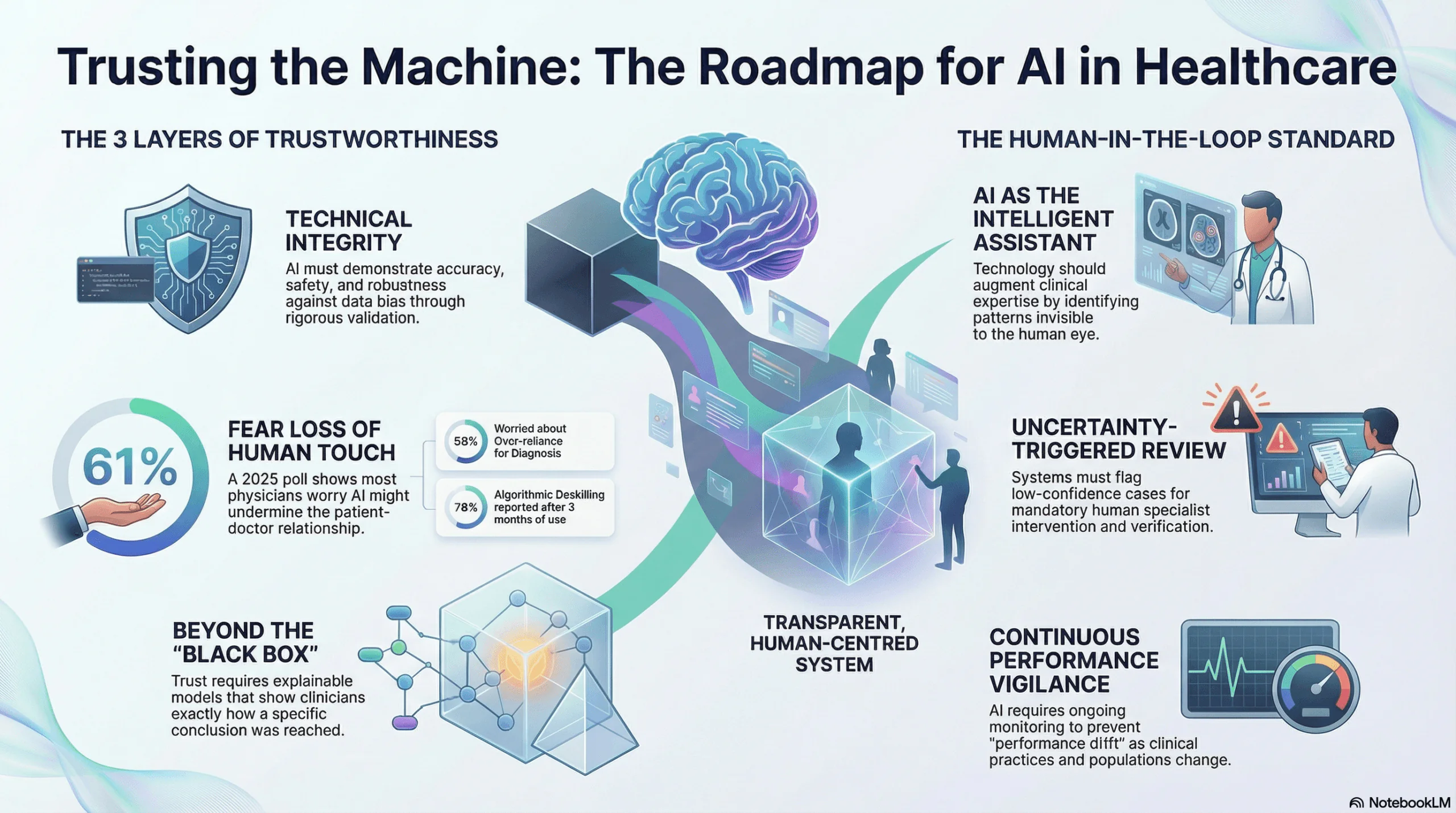
What does this mean in practice? AI accelerates processes, reduces human error, uncovers insights imperceptible to humans, and enables clinicians to make more informed decisions.
But the true power emerges when AI is paired with independent human verification. This partnership, where human expertise is enhanced by machine intelligence, is not just the future of healthcare. It’s the key to unlocking better outcomes, saving more lives, and delivering care that is both cutting-edge and deeply human. When trust and technology converge, healthcare excellence becomes not just a benchmark but a promise we can keep.
 Samer Hassan Solution Service Delivery Manager – Business Technologies |